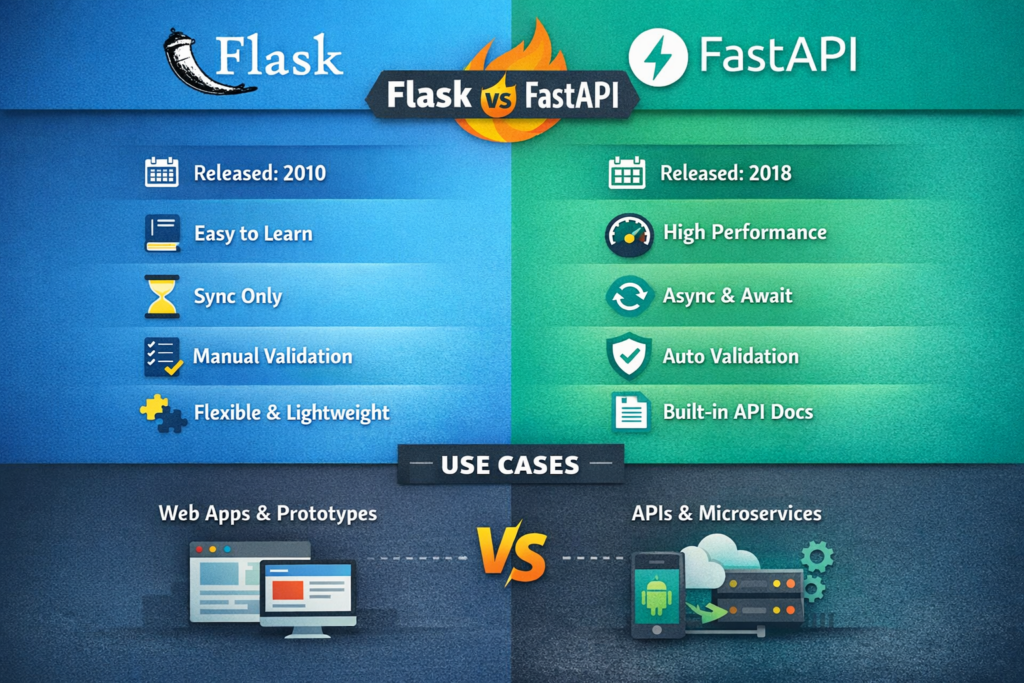
Flask is a lightweight, general-purpose micro-framework, ideal for simple web applications and rapid prototyping, while FastAPI is a modern, high-performance framework explicitly designed for building APIs with robust built-in features like asynchronous support and automatic data validation.
Key Differences
| Aspect | Flask | FastAPI |
|---|---|---|
| Type | Micro Web Framework | Modern API Framework |
| Architecture | Synchronous (WSGI) | Asynchronous (ASGI) |
| Performance | Slower, processes one request at a time | Faster, designed for high concurrency and I/O-bound tasks |
| Data Validation | Manual, requires external libraries | Built-in, automatic using Pydantic models |
| Documentation | Manual, requires external tools like Swagger | Automatic, auto-generated; Swagger UI; and ReDoc UIs |
| Learning Curve | Easy – Gentle for sync Python, easy to get started | Moderate – Slightly steeper (due to async concepts and Pydantic) |
| Ecosystem | Large, mature community and vast extensions | Younger, but rapidly expanding with opinionated, modern libraries |
| Primary Use Case | General-purpose web apps, simple APIs, rapid prototyping | High-performance APIs, microservices, AI/ML model serving, real-time apps |
When to choose which:
- Choose Flask if you need:
- Simplicity and Flexibility: You prefer a minimal core and want total control over choosing your own components and libraries (e.g., ORM, authentication).
- Rapid Prototyping/Small Projects: Its simplicity allows for quickly getting an idea or a small application up and running.
- Server-Side Rendered HTML: It has built-in support for the Jinja2 templating engine
- Extensive Community Resources: Its maturity means almost any problem you face has existing solutions on platforms like Stack Overflow
- Choose FastAPI if you need:
- High Performance and Scalability: You are building I/O-heavy applications that require handling a large number of concurrent requests efficiently (e.g., WebSockets, data streaming).
- Robust API Features Out-of-the-Box: You want built-in data validation, automatic interactive API documentation, and easy dependency injection.
- Modern Python Features: You want to leverage Python type hints and asynchronous programming.
- AI/Machine Learning Integration: It is highly suitable for deploying machine learning models as fast, scalable APIs.
Ultimately, Flask provides flexibility and a mature ecosystem, while FastAPI offers a modern, high-performance, and feature-rich environment specifically optimized for API development.